

Basics of the Trinity
Before I defend a trinitarian doctrine of God, it has come to my attention that the word trinity requires a defense of its own.
This word comes to us from the Latin trinitas, and trinus meaning triad or tri-unity (three things together or threefold). The first use of this term, in a theological sense, is in the third century writings of Tertullian. From this time forward, the word increased in popularity among the Christians, theologians, and authors of the third and fourth centuries until it is officially placed in the vocabulary of the church with documents such as the Athanasian creed and the concept being dogmatized at the first council of Nicaea (AD 325). Because of the long and storied history of the term and its many nuanced definitions, some modern people prefer to avoid the term altogether. From my perspective (which is shared by most Christians in history), the term is adequate to describe the doctrine we believe and largely helpful in discussions. This is not to say that I agree with every nuance of the doctrine of the trinity that has ever been supposed. For example, many Christians today promote so-called social trinitarianism, which, to me, seems to boarder on tri-theism. This difference of understanding does not prevent me from using the term, though.
Some argue that because the word trinity is not used in the scripture, therefore we ought not use it either. This is a simple misunderstanding of language and discussion principles. First, in the early centuries of the church, it was clear that the heretics and false teachers were using biblical language, but the content of their message was clearly unbiblical. There is nothing about using only biblical language that ensures the message will be sound doctrine, for words can be manipulated and misused in a variety of ways. So, the early Christians and Church Fathers quickly realized that to distinguish their intended meaning from the heretics’ teaching, they needed to use extra-biblical words to define biblical ones. Second, if we are being nitpicky about the language we use coming directly from the Bible, then we shouldn’t use the word ‘bible’ since it is not found in either the Old or New Testament. For that matter, we all ought to speak Greek and Hebrew since there is no English, Spanish, French, German, or other modern language words found anywhere in the Bible. It is necessary for all theological discussions—especially in a language foreign to the Bible—to use terms, principles, and definitions that are not explicitly dictated by the biblical authors. This is not a misstep but a further clarification for modern audiences.
Let’s retire the argument that the word trinity is unbiblical, too loaded, or just not right. In as much as it is useful, let’s use it. Now for the doctrine itself.
The basic definition of the Trinity (we will now use the word in its proper sense) says that there is one God existing eternally in three persons, viz. Father, Son, and Holy Spirit.[1] There are at least four ideas within this definition that must be defended in order to affirm the whole doctrine. First, there is only one God. Second, the Father, the Son, and the Holy Spirit can all be called God. Third, as a conclusion from the previous two, the Father, the Son, and the Spirit all share one nature, substance, and essence. Fourth, there are personal distinctions between each of the three. These will occupy the rest of this essay.
Monotheism
This is the belief in only one supreme God (i.e. only one being who is properly God). Just over half of the world’s population belong to a monotheistic religion, though the percentage is growing. The three Abrahamic religions (Judaism, Islam, and Christianity) all claim to worship the one supreme creator and ruler of the universe (whether this is true or not is another question). Thus, classical Christian belief on this issue is by no means a minority. It is widely held that this belief is defensible philosophically, as well as biblically.
Aristotle (c. 384-322 BC) defended the concept of an “unmoved mover”(Metaphysics, Λ, 6-7). Later, the church adapted this argument and language to defend monotheism and proper theology against the pagans.[2] Thomas Aquinas called Aristotle “The Philosopher,” and some Islamic thinkers referred to him as a prophet. His basic argument is that this physical universe is in a constant state of change or flux. And, if something is moving or in a state of change, then it must have been moved by something else. However, if we were to trace the regress of causes, or movers, the series could not be infinite, because, he argues that, if this were true, nothing would be moving now. So, there must be a first cause, a primary being, or an unmoved mover which is eternal and itself unmovable. This reasoning is still used by Christians arguing that there must necessarily be only one unmoved mover, whom we call God. A descendant of this argument is found in the thinking of medieval Islamic philosophy and popularized by William Lane Craig as the Kalam Cosmological Argument.[3] Along with this, many other reasons have been given to defend monotheism over the centuries.
There is also abundant biblical evidence to support the claim that there is only one God. The principal text for this claim in Judaism and Christianity is found in the Shema (Deuteronomy 6.4) which says, “Hear, O Israel: The Lord our God, the Lord is one” (NIV, 2011). Consider also the following from the Hebrew and Christian scriptures:
“Before me no god was formed, nor shall there be any after me” (Isaiah 43.10).
“I am the first and I am the last; besides me there is no god” (Isaiah 44.6).
“I am the Lord and there is no other, besides me there is no God…” (Isaiah 45.5).
“I am God, and there is no other; I am God, and there is none like me.” (Isaiah 46.9).
“For you are great and do wondrous things; you alone are God” (Psalm 86.10).
“…there is no God but one…” (1 Corinthians 8.4).
“Yet for us there is one God, the Father, from whom are all things and for whom we exist…” (1 Corinthians 8.6).
“One God and Father of all, who is over all and through all and in all” (Ephesians 4.6).
“You believe that God is one; you do well…” (James 2.19).
The Bible is clear. There is only one God.[4]
The Deity of the Father, Son, and Spirit
The doctrine that distinguishes Christianity from other monotheistic religions is the belief that Jesus Christ is God. Also important to historic Christianity, though less central in most discussions of the Trinity, is the deity of the Holy Spirit. In contrast to the doctrine of monotheism, the tri-personal nature of God is much less the subject of philosophical discussion and more a debate of competing biblical interpretations.
At this point, it may seem illogical or irrational to believe that there is only one God and believe in three persons who are God. To most, this formula seems impossible:
1: There is only one God.
2: x is God, y is God, and z is God.
3: x, y, and z are not identical.
The resolution to this apparent inconsistency will come later. For now, we are only defending the biblical teaching that Father, Son, and Spirit are divine.
The deity of the Father is more assumed than it is stated. Throughout the Old Testament, there are hints of a plurality in God, but nothing that will have much of an impact on our basic discussion. In the New Testament, Jesus claims relationship to God as a Son to his Father. Then, in teaching his disciples to pray, he instructs that they may also call God “Father.” Thus, from this time forward, many authors call him “Father” as in Ephesians 4.6 and 1 Corinthians 8.6 (see above). The above passages will serve to prove the bible teaching that the Father is God. However, the very term implies a relationship, for there can be no father without a child. The fullest revelation of God comes from the father-son relationship demonstrated by Jesus Christ in the incarnation. The nature of relations within God is, again, a subject for a future time, but here we will just say that God has eternal relations that he has revealed in history and redemption.
In the process of revelation, the creator-God of the Old Testament became known as the Father, as seen above, and Jesus Christ, who claimed to be the Son of God, also came to be called God properly by the New Testament and early Christians. This is much more a point of contention in historic Christianity. Orthodox Christians have believed that Jesus is God since the council of Nicaea. The controversy that occasioned that council was a dispute about the nature and deity of Christ. The Nicene creed stated:
“[We believe] in one Lord Jesus Christ,
the only Son of God,
begotten from the Father before all ages,
God from God,
Light from Light,
true God from true God,
begotten, not made;
of the same essence as the Father.”
This was in response to certain teachers and bishops saying that Jesus was not the same substance or essence as the Father, and he was a created being instead.
I believe that the consensus at Nicaea agrees with the biblical data. The Greek word theos is translated as God in most modern English versions. There are eight times in the New Testament when this term is applied directly to Jesus. If someone were to deny the deity of Jesus, there must be an explanation given for each of these eight scriptures.
1) “…and the Word was God” (John 1.1)
2) “…the only begotten God…” (John 1.18)
3) “My Lord and my God!” (John 20.28)
4) “…Christ, who is God over all, blessed forever” (Romans 9.5)
5) “…our great God and Savior Jesus Christ” (Titus 2.13)
6) “Your throne, O God, is forever and ever…” (Hebrews 1.8)
7) “…our God and Savior Jesus Christ” (2 Peter 1.1)
8) “…the church of God, which he obtained with his own blood” (Acts 20.28)
The force of the language in each of these is difficult to overcome. Even if one could show that one of these passages does not mean that Jesus is God, there would still be seven more powerful positive statements of his deity.[5]
In addition to explicit references, there are several implicit hints of his deity. Jesus is given divine prerogatives such as creation out of nothing (John 1.2-3), sustaining all things by his power (Hebrews 1.2-3), forgiving sins (Mark 2.5-12), judging humanity (John 5.22-29). Also, there many Old Testament texts originally written about YHWH, the God of Israel, that are applied to Jesus. These include but are not limited to: Isaiah 40 in Mark 1.2-3, Joel 2.32 in Romans 10.9-13, Isaiah 45.23 in Philippians 2.9-11, and Psalm 102 in Hebrews 1.10-12. Jesus also receives worship and cultic devotion beyond merely admiration (e.g. Matthew 14.33, John 9.38, and Hebrews 2.6). Throughout the New Testament, the Greek word kyrios is used to translate the name YHWH in Old Testament quotations. This term is then consistently applied to Jesus. It is possible to translate kyrios as “sir” or “master,” but the overwhelming force of the argument seems to prevail. A few examples include Romans 10.9-13, Philippians 2.11, and 1 Corinthians 12.3.
Beyond the text of the New Testament, an often-overlooked field of evidence is early Christian art, scribal culture, and archaeology. It is clear from the way Christians depicted Jesus in art and literature that they believed him to be more than a mere human. For simplicity, we will mention just one case.
In the early copying of the New Testament, scribes began to use shortened forms of special words. Exactly how and when this began is a subject of debate. Regardless, words that referred to God such as theos, and kyrios were abbreviated and a horizontal line was placed above it (see the image below). It is generally understood that this was a form of reverence to those names or descriptors. However, in many of the earliest manuscripts, the Greek words for Jesus, Christ, and Son are also treated in this same manner. Together these abbreviations are called the nomina sacra (Latin for sacred or holy names). Again, their exact origin and meaning is debated but it seems that the early Christians were demonstrating their belief in a shared nature, or at least a shared position of reverence and worship, of the Father and Jesus Christ his Son.[6]
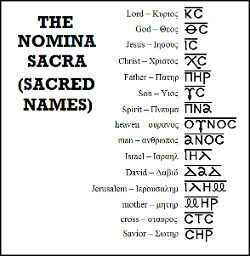
In summary, the deity of Jesus is clearly seen through explicit statements, implicit hints, and early Christian attestation through literature and art.
Finally, the revelation of God’s nature in the New Testament continues with the deity of the Holy Spirit. The Spirit is discussed more in the Old Testament than the Son, but there is still little about his precise status in the divine nature. Modern Jewish interpretation of the Hebrew Bible sees the Spirit as the action of God, his wisdom, or God’s own presence but not as a person distinct from the Father. In Jewish thought, the phrase “Holy Spirit” does denote something specific within God’s nature or action but not a person. However, the New Testament seems to place the Holy Spirit within the divine nature as well. (I will discuss the distinctions in persons in the section below.)
There is probably one place in the New Testament when the author applies the word theos to the Spirit directly. In Acts chapter five, Ananias and Saphira conspire to lie about the money they give to the apostles. Peter says that Satan has filled their heart to lie to the Holy Spirit. Then in the next verse he says that they have not lied to men but to God (theos). This is more circumstantial admittedly, and there could be other possible interpretations, but this is the most plausible reading in my view.
The more compelling arguments for the deity of the Holy Spirit are from implicit statements. In many places in both the Old and New Testaments, the Spirit is connected to God’s indwelling presence in the temple and in humans. In 1 Corinthians 3.16-17 and 6.19 Paul declares that the Christians are the temple of God and therefore the Holy Spirit dwells in them. Furthermore, the Spirit is said to possess many of the divine attributes and performs uniquely divine actions. Notice the following:
1) The Spirit searches everything and knows the thoughts of God (1 Corinthians 2.10-11).
2) The Spirit exists eternally (Hebrews 9.14).
3) The Spirit participates in salvation and indwells believers (John 3.5-8; 1 Corinthians 6.11; Romans 8.9-11)
4) Blasphemy against the Holy Spirit is a grave sin (Mark 3.28-30).
5) The Spirit is closely identified with God (2 Corinthians 3.17-18).
There is one final scripture which, in my view, makes the strongest case that Father, Son, and Spirit are all divine. In committing to the apostles their mission, Jesus says, “Therefore go and make disciples of all nations, baptizing them in the name of the Father and of the Son and of the Holy Spirit...”(Matthew 28.19). In the name (singular) of these three, men are baptized for the forgiveness of their sins. There is no qualification or caveat about one or two being of a secondary nature or of a different substance. Father, Son, and Spirit are all placed together in one name. It seems nearly impossible to explain this in another way, but we will have more to say about this later.
One Nature
That there is one God is clear in the Bible. That the Father, Son, and Spirit are all properly called God is also evident. This third point is simply a conclusion from the previous two premises. If the first two are true, then this follows necessarily. There is but one divine nature, substance, or essence shared by all three.[7] Although this follows, it was a serious point of contention and careful definition in the early centuries of the church. The term that has been used to describe this doctrine historically is the consubstantiality of the Father, Son, and Holy Spirit.[8] That is, these three are the same substance.
To be fair, there are other ways to interpret the statement “There is one God.” This could mean that there is only one being who is God (the position taken here). But some have taken this to mean that there is one divine nature just as there is one human nature. Though there is one nature in humanity, there are many individuals with distinct minds, wills, centers of consciousness, and souls who are separate instances of a common nature. Some have argued that there is one divine nature in which there are three instances, or separate persons who have distinct minds, wills, centers of consciousness, and souls. While some of this language is difficult to parse and understand, it seems clear that this cannot be the biblical doctrine of God, because it would inevitably lead to tri-theism (the belief in three gods). My biological father and I are different persons, yes, but we are also different beings because we do not share the same mind, will, center of consciousness, soul, body, etc. If someone asked how many humans are in the world, the correct answer would be “eight billion,” because there are eight billion instances or individuals and beings with a common human nature. This is not true of God. If someone asked how many Gods exist, the correct answer would be “one,” because there is only one being who is God. Without getting into the details of personhood and nature, suffice it to say that there is only one being which is God, not three.
So, what is it that the Father, Son, and Spirit share? If they are united in one being, essence, substance, and nature, what does that entail?
Paul would write that Christ possess the fullness of Deity in bodily form (Colossians 2.9). While this could be understood to mean a few different things, the clear intention is that Christ has the divine nature, and this he shares with the Father and the Holy Spirit. In context, Paul indicates that this entails several things. 1) The Divine being is authoritative over creation. 2) The Divine being can save and forgive mankind. 3) The Divine being is worthy of reverence and worship. These are things clearly shared by Father, Son, and Holy Spirit.
There is much more that is shared as well. The Bible is clear that the Divine nature is eternal (Psalm 90.2), all-powerful (Genesis 18.14), all-knowing (Psalm 147.5), everywhere present (Psalm 139.7-10), and holy (Isaiah 6.3). These are all attributes of the Divine nature that is shared by Father, Son, and Holy Spirit.
When Christians say that these three are consubstantial, we mean that they share a common substance. A substance is not a physical material. We are not saying that they share one body. Instead, substance refers to what God is—to use a common term—the stuff that is God. It is not physical because God is not physical. God is spirit (John 4.21-24). There is one ‘what’ that is God. There are not three beings, three substances, three stuffs, three ‘whats.’But there is one being, one substance, one stuff, one ‘what.’
There is so much more to say on this issue, but this will suffice for a basic understanding of the Trinity.
Distinct Persons
In the last section we asked what is shared by the three persons. Now we turn to what is distinct between them.
You may have noticed that, as much as possible, we have refrained from calling the Father, Son, and Spirit persons to this point. We have not yet shown biblically that they are distinct from one another and not just different modes of one person. Early in church history, some supposed that the Father, Son, and Spirit were only three personalities or modes of expression in one person. Just as one human person could be a father, son, and husband all at once, some people supposed that the same could be true of God. This was denounced as heresy very early in church history because it leads to several faulty interpretations and practices. The formal term for this false teaching is modalism.
If modalism is true, then God is one person who relates to the world in three different ways. However, this is impossible given the New Testament data. There are many instances when the Father speaks to the Son, the Son speaks to the Father, or one of them speaks to or with the Holy Spirit. If God is only one person, then this seems incoherent. It would amount to one person speaking to himself. Take for example the baptism of Jesus. At that event, the Son of God is baptized in the Jordan river, the Father speaks to him from heaven saying, “This is my beloved Son in whom I am well pleased,” and the Holy Spirit descends upon the Son as a dove. If modalism is correct then one person was raised from the water, that same person spoke to himself expressing his pleasure with himself, and then the same person descended as a dove on himself. This interpretation makes absolutely no sense. Therefore, we must reject that there is only one person in God.
Can it be proven that the Father, Son, and Spirit each possess the qualities necessary to be called persons distinct from one another? I think the Bible gives plenty of reason to believe this is true. As we have already seen in the baptism of Jesus, each of the three speak or relate to one another as distinct persons, but there are many more events like this in the New Testament.
1) In many places (John 17 for example), Jesus prays to the Father as though he is a distinct person.
2) Jesus says he is going to the Father (John 14.12).
3) Jesus (the Son) says the Father will send the Holy Spirit (John 14.26).
4) Jesus says he will go away, he will send the Spirit, the Spirit will glorify him, and all that the Father has belongs to him, which is why the Spirit will receive from Jesus what he will make known to the disciples (John 16.7-15). The Son, Father, Spirit, and disciples are all treated as different parties in this scheme.
5) The Spirit intercedes in our prayers to the Father (Romans 8.26-27).
6) Jesus can speak of himself in the first person and of the Father in the second person throughout the gospel accounts.
7) The Spirit speaks in the first person (Acts 13.2).
8) God sends the Son in the incarnation and, at a separate time, sends the Spirit into our hearts (Galatians 4.4-6).
All these show that the persons in the divine nature are distinct in their relations to one another and to humanity.
In addition, the incarnation of Christ is demonstrative of this same point. The Bible does not indicate that the Father became human or that the Spirit took on flesh. We could not properly say that the Father died on the cross for the sins of mankind, nor could we say that the Spirit was tempted by Satan in the wilderness. So, there must be distinctions in the three persons, such that something could be true of one person and not true of the other two.
The classic example given is drawn from the speech of Jesus in his final discourse to the apostles (John 14-16). There, Jesus says that the Father sent him. Therefore, the Father is the sender. This is not true of the Spirit, for example. The Son is sent by the Father alone. The Spirit did not send the Son. The Spirit is sent by both the Father and the Son. This is not true of either of the other persons. It is clear in this discourse, that certain relational qualities are true of one person and not the others.
This section could easily be the longest of the whole essay. There have been thousands of volumes written on the proper way to understand and describe the relations between the Trinity. The simple point for this basic introduction is this: The Father, Son, and Spirit are not all one person with different modes of expression. They are distinct persons with relation to one another eternally.
Conclusion
This is the doctrine of the Trinity. It can be simply stated as this: We believe that there is one God who exists eternally in three persons. However, the bible has much more to say than just this. The church through the ages has come to understand a great deal about the mystery of the Trinity. This article serves to introduce the reader to some of the reasoning behind the doctrine. It is my hope that it serves the reader well. It would be appropriate to end with the same prayer that Augustine wrote at the end of his long work on the Trinity, De Trinitate.
“O Lord the one God, God the Trinity, whatever I have said in these books that is of Yours, may they acknowledge who are Yours; if anything of my own, may it be pardoned both by You and by those who are Yours. Amen.”
[1] This essay is interested only in the simple definition common to historic Christianity. There are a variety of nuances that have been and are still debated amongst Christians, but we will reserve comment on them for later articles. For a helpful resource establishing the basics of trinitarian theology see Swain, Scott R. The Trinity: An Introduction. Edited by Graham A. Cole and Oren R. Martin, Crossway, 2020.
[2] I use this term in a general sense to denote those who were not Christians, not in a technical or sociological sense.
[3] Craig, William Lane. “The Existence of God and the Beginning of the Universe | Scholarly Writings | Reasonable Faith.” Reasonable Faith - The Existence of God and the Beginning of the Universe, www.reasonablefaith.org/writings/scholarly-writings/the-existence-of-god/the-existence-of-god-and-the-beginning-of-the-universe. Accessed 23 June 2026.
[4] There is a small caveat to this statement. It is true that the Hebrew word translated as God (Elohim) is applied to more than just YHWH, the God of Israel. It is used to talk about spiritual beings, angels, so-called false gods, etc. So, when I say that there is only one God, I mean that there is only one being who properly fits the exclusive definition of God understood here. I realize also that I have not yet given that definition to the reader. This is only to keep the discussion as simple as possible. There will be a future article on the proper definition of God. As of this point, we are calling God the unmoved mover. For those interested, the fuller definition of God that I prefer is the one given by Anselm of Canterbury in the phrase “aliquid quo nihil maius cogitari possit” (that of which nothing greater can be thought).
[5] For more on these eight passages see Harris, Murray J. Jesus as God: The New Testament Use of Theos in Reference to Jesus. Wipf and Stock Publishers, 2008.
[6] For a fuller treatment of the nomina sacra and their import see Hurtado, Larry W. The Earliest Christian Artifacts: Manuscripts and Christian Origins. Eerdmans, 2008.
[7] For now, I am using the terms nature, essence, and substance somewhat interchangeably. However, for future reference, there is a difference between them and a future article will explain them more fully.
[8] For a complete discussion of the development and meaning of consubstantiality see Butner, D. Glenn. Trinitarian Dogmatics: Exploring the Grammar of the Christian Doctrine of God. Baker Academic, a Division of Baker Publishing Group, 2022.
